![Working From Home Statistics UK Edition [2024]](https://cdn.cybercrew.uk/images/posts/working-from-home-statistics-uk/large.webp)
Amid the pandemic and causal lockdown, many of us experienced the charms of working from home. All is not ideal, though, and some are even reconsidering coming back to the offices.
How many people worked from home, what they have said about that kind of business model, and do they plan on working like that in the future and other working from home statistics UK you will find out in this article.
It’s not unusual for people to find it challenging to concentrate on work while being at home. Others seem to be more productive under the same conditions.
The office environment breeds efficiency, but it could also instigate unnecessary tension in the air. On the other hand, a home is a place of cosy, rest & relaxation. Some might find all that a necessary addition to their work routine to boost their productiveness.
All being said, it is not so surprising percentages are almost evenly divided among people. But what of the division by sexes?
From this homeworking statistic, we can see that male workers were just a tad more open to working from home than female workers were.
But the dedication to work under any condition demands the sharp mind of experienced adults. How prepared were different age groups for the change in workplace scenery?
 Looking at these statistics, we can conclude that younger generations weren’t too keen on working from home, while older ones had no such reservations. 2021 followed the same trend.
As one of the most notable workers from home, freelancers between the ages of 40-49 and 50-59 years were the most prominent age groups in 2020, accounting for 50% of all freelancers in the UK.
We expected many users to cite COVID-19 as the reason for switching to the home office, but the resulting number was still staggering.
Greater responsibilities toward one’s household come with age, so these numbers aren’t that surprising, considering there is no commuter’s hell, and the benefit of more time for house chores in-between breaks.
Now, if these following statistics seem like a déjà vu to you - thanks! It means you’ve kept on reading and haven’t dozed off .. yet.
But more importantly, these are comparable statistics of people that listed coronavirus as the main reason for working from home divided by regions.
As England’s capital, it was to be expected London would be the most affected by the outbreak, and in effect, had the highest percentage of homeworkers, but 4/5th is still high for the rest of the country as well.
Now, let’s see how Londoners feel about working out of the office.
So as you might have noticed, many people have and probably still are working from home, but which professions are suitable for remote work?
Looking at these statistics, we can conclude that younger generations weren’t too keen on working from home, while older ones had no such reservations. 2021 followed the same trend.
As one of the most notable workers from home, freelancers between the ages of 40-49 and 50-59 years were the most prominent age groups in 2020, accounting for 50% of all freelancers in the UK.
We expected many users to cite COVID-19 as the reason for switching to the home office, but the resulting number was still staggering.
Greater responsibilities toward one’s household come with age, so these numbers aren’t that surprising, considering there is no commuter’s hell, and the benefit of more time for house chores in-between breaks.
Now, if these following statistics seem like a déjà vu to you - thanks! It means you’ve kept on reading and haven’t dozed off .. yet.
But more importantly, these are comparable statistics of people that listed coronavirus as the main reason for working from home divided by regions.
As England’s capital, it was to be expected London would be the most affected by the outbreak, and in effect, had the highest percentage of homeworkers, but 4/5th is still high for the rest of the country as well.
Now, let’s see how Londoners feel about working out of the office.
So as you might have noticed, many people have and probably still are working from home, but which professions are suitable for remote work?
It would seem employees in higher positions worked from home more so than the rest during the lockdown in 2020. Other occupations like sales, customer support, caring services and others had less than 20% of people working from home.
Show Must Go On! - could have been a business model for the year 2020. Business continuity plans were clearly in effect, but surprisingly, only a quarter of the UK office workforce was actually working from home.
Not too many people were confined to the home office before 2020, but things changed for some during the quarantine. Their numbers flourished to an extent, but it would seem most will be back in the office soon enough.
As a strategy in development, working from home proved seemingly beneficial to both companies and employees.
How many people worked from home in 2020 during the Pandemic?
As we can see from the UK’s workforce statistics, at the beginning of 2020, not too many people have worked from home. However, as the coronavirus situation developed, many started working from home, whether by choice or a corporate policy.
Let’s check out the statistics showing how many people returned to their usual workspace.
The lockdown had shown people that working from home was not only possible but could be more efficient as well.
It would seem the notion of working from home didn’t sway a fair share of people. In the face of social distancing, it is understandable why one might feel nostalgic for the meaningful conversations next to the office water cooler.
We can see that people still prefer to attend meetings in person rather than have them online. Some things are simpler to explain when you are in the same room with your colleagues, which could easily be misinterpreted during a remote session.
There are certainly some setbacks when working remotely, like isolation and lack of human interaction, but there are advantages to it, some of which are a point of focus of this next topic.
Besides no commuting, people said that spending time with their families and saving money are also key benefits of working remotely.
Interestingly, people that said their productivity was lower only occasionally worked from home. By contrast, those who work from home all the time have said that they do more work per hour than they did so before the lockdown.
Somewhat ironically, the last group, which was against working from home, also admitted their productivity increased during the same period.
Working From Home Statistics UK - Fascinating Stats
- 5.6 million people worked from home in the UK in 2020.
- The UK employees worked from home an average of 35.9 hours a week.
- As of 2021, 28% of younger workers aged between 16 and 29 worked from home.
- 50% of Londoners would prefer to go back to the office if asked to.
- Almost 1/5th of UK businesses claimed they were switching to remote work entirely.
- In July 2021, 60% of workers in Great Britain who worked from home said that they were asked by their employers to do so.
- In 2021, 40% of the respondents in the UK reported substantially improved perceptions of working from home.
- 79% of respondents have said that the most beneficial thing related to working from home is that there is no commute.
- Roughly 70% of UK professionals have worked remotely in April 2020.
- 15% of surveyed people in the UK preferred working from home daily.
Working From Home Statistics UK: Hours
We’ll start off by saying that nearly 5.6 million people worked from home in the UK in 2020 so that we can show you statistics on homeworking by hours.30.3% of surveyed people in the UK have stated they worked from home more hours than usual
34.4% of UK employees said they worked from home fewer hours than usual
Of home workers in the UK, 35.2% said they worked as much as they would under normal circumstances
The UK employees worked from home an average of 35.9 hours a week
Working From Home Statistics UK: Gender
Would you believe me if I told you there is a slight difference between the percentage of men and women working from home when it comes to the surveyed sample of 16+ year-old employed homeworkers in the UK? Let's compare female and male workers in 2020:15.1% of female workers worked from home
19.4% of male workers worked from home
Working From Home Statistics UK: Age
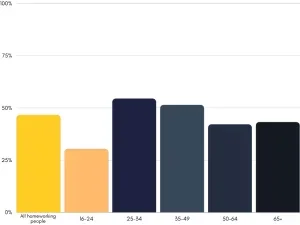
To celebrate the fact that we love graphs, here’s one depicting percentages of home workers divided by age groups. Enjoy!
Just 30.2% of the employed aged 16 to 24 years were inclined to work from home
54.3% of those aged 25 to 34 years and 51.3% aged 35 to 49 years have worked from home at some point in April 2020
Compared to those who worked from home before the COVID-19 pandemic, older workers are more likely to plan to work from home following the pandemic
As of 2021, 28% of younger workers aged between 16 and 29 worked from home
44% of UK people aged between 30 and 49 have worked remotely as of June 2021
95.2% of UK people aged between 16 and 35 cited coronavirus as the primary reason they’ve worked from home in 2020. The percentage of homeworkers who were 50+ years old and said the same was 76.1%
In July 2021, 60% of workers in Great Britain who worked from home said that they were asked by their employers to do so, and 42% said that they followed government advice
Working From Home Statistics UK: Regions
18.9% of employees stationed in London worked from home in 2020. Let’s have a look at the other regions as well.In 2020, South West and South East each had 20.5% of workers who worked from home
West Midlands, Wales and East Midlands all had similar 17% of people who worked from home
Scotland and North East had the lowest homeworking rates - 14.5% and 13.2%, respectively
91.6% of Londoners have decided to work from home due to COVID-19
79.1% of people in the North East and 76.6% in the South West have cited coronavirus as a reason
As of 2021, 50% of Londoners would prefer to go back to the office if asked to, while 46% of employers would rather quit than go back into the office full time
UK Homeworking by Trade
Working from home in the UK as an option was mostly reserved for more qualified and experienced workers. The following table shows us which jobs and to which extent were done remotely in April 2020.|
Occupation |
Percentage |
|
Professional occupations |
69,6% |
|
Directors, Managers and Senior Executives |
67,3% |
|
Associate Professionals & Technical |
63,7% |
|
Administrative & Secretarial |
57,2% |
|
Skilled trades |
18,9% |
|
Caring leisure and other services |
14,9% |
|
Sales and customer service |
15,9% |
|
Process plant and machine operatives |
5,4% |